For executors and next of kin
The Executor’s Companion is a fillable working file for someone administering an estate right now. Every decision, phone call, payment and letter, logged in one place, so the job moves forward even on the hard days.
The job
Certificates, banks, retirement accounts, utilities, insurers. Phone calls that need to be made twice, letters that need the right wording, receipts that need to be kept. Most executors run the whole thing from a notepad and a worry list. The Companion gives the job a home.
Every organization asks the same questions, and each one starts from the beginning. Phone calls get made twice because nobody wrote down the first one.
In the Companion: Contacts and Correspondence. Who you spoke to, when, what was said and what happens next.
Each notification needs the right wording, and there is no easy way to remember which organization has already been told.
In the Companion: ready-to-adapt letter templates and a notification register, so each organization gets told once, properly.
Estate expenses come out of somebody’s pocket first, and the record of that gets kept in a wallet, a text message or a memory.
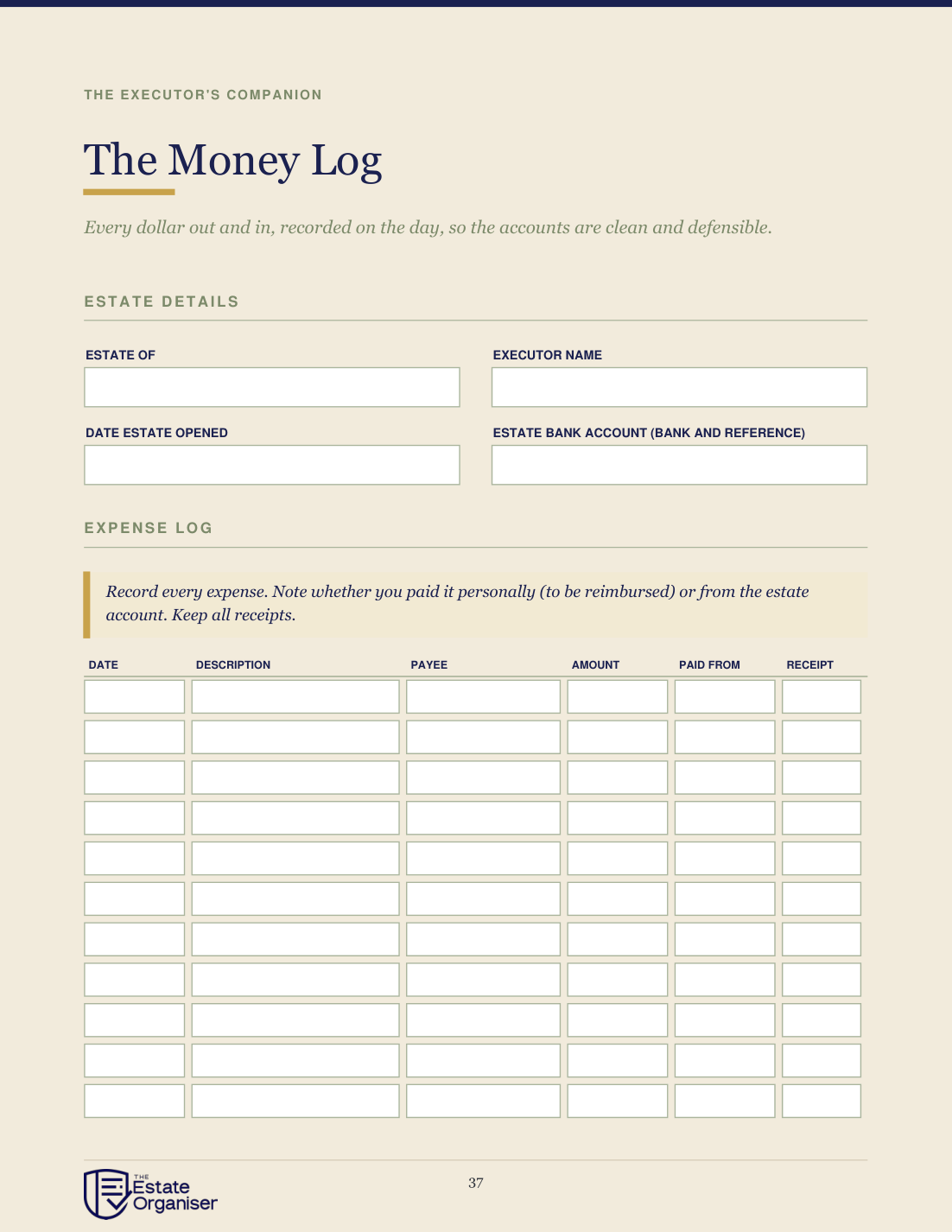
In the Companion: The Money Log. Estate expenses, money in, and reimbursements, recorded as you go.
What’s inside
From the first days through to the final sweep, in the order the job tends to unfold. You do not read it cover to cover. You open the section you are standing in.
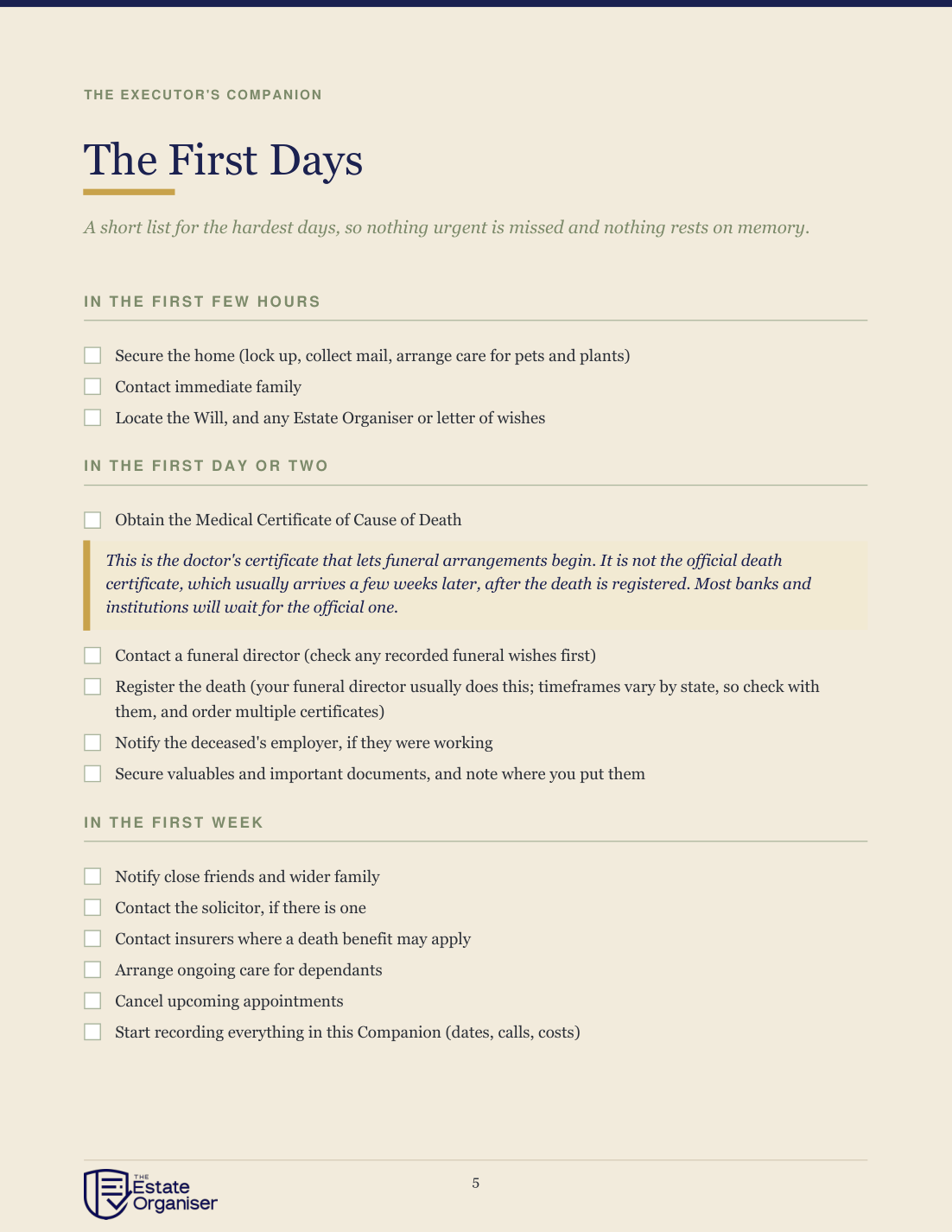
A steady checklist for the first week or two, including the paperwork most families are asked for early, and what tends to be needed when.
Without it: the early paperwork gets found twice, because nobody noted where the first copy went.
The longer arc of an estate, laid out so you can see where you are and what usually comes next.
Without it: no sense of where you are in the job, so every week feels like the first one.
Seventeen checks drawn from the traps that catch families again and again, so you can look before you step.
Without it: the same traps, found the slow way, one at a time.
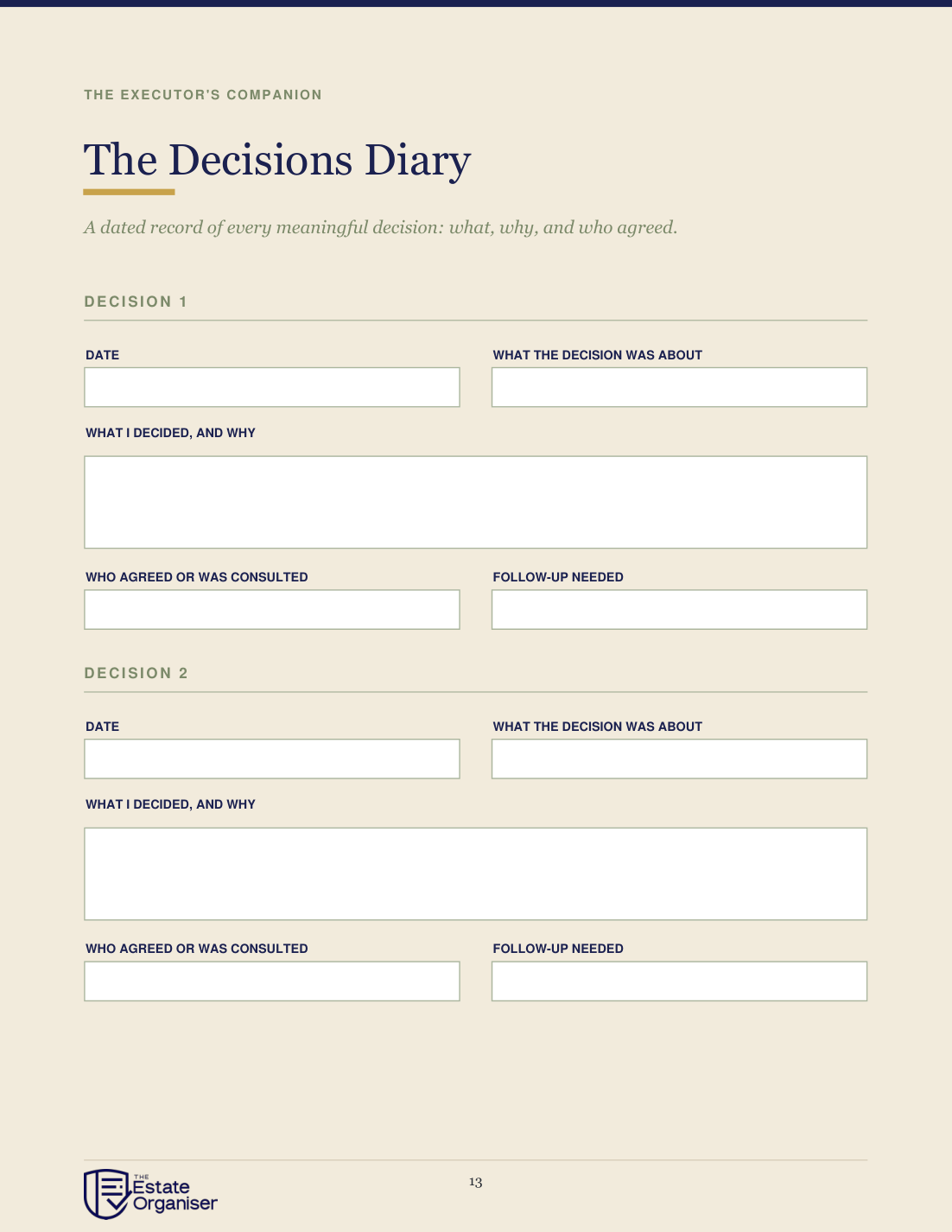
A dated record of the decisions you make and why. Useful for your own peace of mind, and for keeping everyone on the same page.
Without it: a decision made months ago, and no note of why you made it.
Who you spoke to, when, what was said and what happens next. No more repeating the story to every department.
Without it: the same conversation had twice, with nothing to point back to.
Ready-to-adapt letter templates and a notification register, so each organization gets told once, properly.
Without it: an organization that never got told, and finds out much later.
Estate expenses, money in, and reimbursements, recorded as you go. The record most families wish they had kept from day one.
Without it: money you paid out of your own pocket, with nothing left to show for it.
Question prep and meeting notes, so paid time gets spent on answers rather than catch-up.
Without it: the question you meant to ask, remembered in the car on the way home.
A simple rhythm for updating family and beneficiaries, because silence is where tension tends to grow.
Without it: a family left wondering, and quietly assuming the worst.
A short monthly review that keeps the estate moving without it taking over your life.
Without it: weeks where nothing moves, and nobody notices until something is overdue.
A closing checklist for the end of the job, so you can finish knowing what has been done and where the record lives.
Without it: an ending you are never quite sure you reached.
The same estate, two ways
Same phone calls, same organizations, same months. The difference is whether any of it was written down while it was still fresh.
A look inside
You fill the Companion in on your own computer, or print it and write by hand. Your family’s details stay in your home, not in an app or on someone’s server.
Being straight with you
Worth saying plainly, so you know what you are getting before you are counting on it.
The Companion is not a Will, a Power of Attorney, or any other legal document. It is the record you keep while the job is being done.
It is a record-keeping and organization tool. It sits alongside professional advice, not in place of it. Many executors use it to make their lawyer and accountant time count.
A fillable PDF you can type into, or print and fill in by hand. Nothing is stored online, so there is nothing to be breached.
Rules and timeframes vary from state to state. The Companion keeps things general and gives your questions a place to live until you can put them to a qualified professional.
What readers are saying
From readers of The Estate Organizer and the free Executor Toolkit.
“All the information in my head right now will not be available to the unlucky sod who has to work out my estate.”
Greg
“I used to work for lawyers, so Wills were a daily situation. I believe everyone with assets needs one.”
Connie
“Practical, with very helpful tips at the beginning of each section. A comprehensive guide to a sensitive but important life issue.”
Pam
“I enjoy your writing. It is like talking to a really smart friend.”
Marlene
One payment
One payment. One fillable PDF, 59 pages, typed on a screen or printed and filled in by hand.
$39 USD
One time. Instant download, digital and printable.
Open the section you are standing in, and fill in that page.
30 days to change your mind. The Companion is for the estate in front of you. The Organizer is for your own: see The Estate Organizer.
30 day guarantee
Try it for 30 days, risk free. Work through it, and if it is not right for you, email us within 30 days for a full refund. No questions asked.

Questions
It is a working file, not a book to get through. Open The First Days, which is a steady checklist for the first week or two, and fill in that page. The rest can wait until you are standing in it. Nothing here needs to be read cover to cover for the next part to make sense.
Either way. It is a fillable PDF you can type into, or print and fill in by hand. No account, no app, no subscription.
No. It is written for executors and next of kin, and it is often the person quietly doing the running around who fills it in. Nothing in it depends on your title. If more than one of you is helping, one shared file is easier than three sets of notes.
Yes, and that is how many executors use it. There is a section for working with a lawyer, with question prep and meeting notes, so paid time gets spent on answers rather than catch-up. The Companion sits alongside professional advice, not in place of it.
It records and organizes the job, and it keeps things general. Rules and timeframes vary from state to state, so the Companion gives your questions a place to live until you can put them to a qualified professional. It is not legal advice and it does not tell you what your state requires.
No. You fill the Companion in on your own computer, or print it and write by hand. Your family’s details stay in your home, not in an app or on someone’s server.
The free Executor Toolkit is the map: a Day 1 to Month 12 roadmap that explains what tends to happen and when. The Executor’s Companion is the working file where you actually run the job. They are built to sit side by side, and the Toolkit stays free.
The Executor’s Companion is an information-gathering and record-keeping tool. It is not legal, financial or tax advice, and it is not a Will, Power of Attorney, or any other legal document. Estate and probate rules vary from state to state and change over time; consult a qualified lawyer, accountant or financial advisor for advice specific to your circumstances.
Why it helps
Estates are rarely hard because of one big thing. They are hard because of two hundred small things spread over many months. When each of them has a place to land, the job stops living in your head at 2am.
Get the Companion, $39